
Community Champion Spotlight: Janell Dymus-Kurei
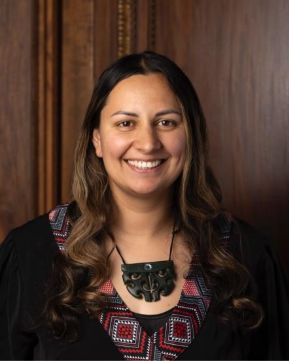
Each quarter, Healthy Families East Cape like to put the spotlight on a community champion, someone working within our Te Tairāwhiti community who is supporting, creating positive and transformational change towards the wellbeing of all people in our rohe.
This month, we are putting the spotlight on Janell Dymus-Kurei
Ko wai koe, nō hea koe?
My name is Janell Dymus-Kurei and I am from Te Whakatōhea, a small, yet mighty iwi in the Bay of Plenty. I’m privileged to have been raised in the village of Waioweka Pā and in the community of Ōpōtiki. I also descend from Te Whānau-ā-Apanui, Tūhoe and from Poland on my mothers side.
So yes, he mokopuna tēnēi nō ōku tātai heke. I’m also a Māmā to my two tamariki. When I say they keep me on my toes, there’s this African Proverb that says “every day in the Serengeti, the Gazelle wakes up and starts running. It knows it must outrun the lion or be eaten”. My Tamariki are eight and four. I’m not sure who is lion and who is Gazelle, but we both wake up and start running every morning – some days, physically, some days we just run our mouths. Either way, when you ask “Ko Wai koe?”, this is who I am.
Kei te aha?
Kei te ora pai…Kei te whakatipu Tamariki, whakatō maara, kauria ngā wai o ōku mātua tīpuna (ahakoa te mātaotao o te wai i tēnei wahanga o te tau), noho whakaiti ki taku hapori. Koina noa.
How did you get your name and what does it mean?
I don’t actually know how I got my name. I didn’t have the most stable early childhood, so I never really had the opportunity to ask that question or have it answered.
What was your favourite story, book or movie growing up?
I was a bookworm growing up and really loved reading. My favourite books were the Tamora Pierce series beginning with First Test and the three books that followed it. I remember getting completely absorbed in those stories as a kid – they were about a girl who disguised herself as a boy to become a knight. Probably what drew my early feminist / mana wāhine inclinations.
What's one of the most special or memorable moments in your mahi, and why does it stand out to you?
Much of my work sits at a systems level, working in the social determinants of health, so often the impacts of that work are long-term and not immediately visible, which sometimes has you questioning, particularly when the impacts are real and now.
But one of the most memorable chapters of my career was the 2024–2025 year when I received a research fellowship and moved to the United States with my children. We packed up our lives and moved to Colorado, where we lived for a year. My mahi gave me the opportunity to sit as teina with Turtle Island indigenous nations, to understand some of their legal systems, some of their rongoā practices, and the broader US health policy landscape. There were many memorable moments in that time - new experiences, new learning, and seeing the world through a different lens. We missed home deeply, and in many ways that experience reminded us just how important home is. It ultimately became one of the reasons we returned home to Ōpōtiki.
What is something everyone should know about your community?
My community is Ōpōtiki. It’s the land and waters that sustained me in childhood and helped nurture me into the person I am today. I’ve been away from this community for 12 years – leaving for University, and then making sure I filled my kete before returning home, so returning has felt like both a homecoming and a rediscovery.
One thing I would say about Ōpōtiki, and actually all of Tūhoe, Te Whakatōhea, Ngai Tai and Apanui is that success and brilliance look different for every person and every whānau. A lot of emphasis was put on academic achievement when we were younger, but our community has self-sustainability at its doorstep, people connection in action and reo and cultural keepers like no other. The media will play its games and governments will play theirs, but the community continues as it always has - supporting each other, challenging each other and carrying on.
What legacy do you want to leave behind?
Probably no legacy at all. I say that because many people came before me laying the groundwork for the work I now do, and many more will come after me to sustain and grow it beyond my time. Sustainability is a legacy. Intergenerational transfer is a legacy. Healthy ecosystems are legacies. I see myself as one small part of that continuum and of that ecosystem.
What is a good piece of advice you’ve ever been given?
When you start a job, write your resignation letter and put it in your back pocket, and never be afraid to use it. For me, that advice is about values and boundaries. It reminds me that we should never feel trapped in our roles, and that we should always be clear about our standards and when we need to take action to maintain our standard. This is a practice I actually take the time to do. I write a physical resignation letter at the start of every job, making sure I am clear on my intentions before stepping into the work itself.
Is there a song, haka, prayer or quote that makes you feel connected to your people or your home? What does it mean to you?
Pinepine te kura, hau te kura
Whanake te kura i raro i a Rūa
Ko te kura nui, ko te kura roa
Ko te kura nā Tuhaepo.
Tēnei te tira hou, tēnā haramai nei
Nā te rongo pai, nā te rangimārie.
These words speak about the value of something precious, and also about the coming of a new generation. Each generation can declare tēnei te tira hou - that a new collective is arriving. It reminds us to move forward with humility, peace and purpose.
If we visited your community, where would you take us and what would you want us to see, taste or experience there?
Easily the first stop would be Waioweka Pā. Within that small papakāinga we have our marae, our kōhanga, our kura, and our kaitiaki who care for the whenua. Our systems of living and learning are all alive there in one place. I never forget that this is the place taught me how to be in the world. I’d want people to experience the beauty of sitting peacefully in irapuaia, held in karakia, or the laughter of all the little Heekin kids playing Bull-rush. Mostly just moments of nostalgia from my childhood that are, what I recognise in adulthood, to moments of joy in what can sometimes be a taumaha world.
What is one small, everyday thing that brings you joy – like a food, a place, or a fun activity?
I love to paddle waka ama. I picked up paddling at University, parimarily to win a trip to Hawai’i, but over the years it has been the thing that has taught me patience, taught me to observe the water before moving, and in recent times has also become my way of giving back and connecting with my Tamariki.
If you could share a message with young people in Tairāwhiti who want to support their communities, what would you say to them?
Remember that you are descendants of ariki. You are mokopuna of greatness that has been carried generation after generation. Serving your own people carries responsibilities that don’t move or change, but the way we choose to serve, and the joy we find in that service, is what shapes our lives. Choose joy, and impact will always follow.
Who is a community champion you know that is awesome for their community?
I know its presumptuous to promote your own friends, but one person that I know who is awesome for their community mahi, not here in Te Tairāwhiti, but in Raahui Pookeka (Huntly) in the Waikato rohe is Sheryl Matenga. She’s a staunch advocate for māmā and pēpi, has carved out space and ensured voice for rangatahi, she’s an amazing community connector, and an all-round amazing human. Even in her trials and tribulations, she manages to show up to her community with a smile.